Showing posts with label Aircraft Carriers. Show all posts

USS Gerald R. Ford (CVN-78)

The USS Gerald R. Ford (CVN-78) is a nuclear-powered aircraft carrier in service with the US Navy since 2017. She is the largest carrier ever built and it is the flagship of her class of four vessels. Her sister ships of her class are USS John F. Kennedy (CVN-79), Doris Miller (CVN-81), and Enterprise (CVN-80); all three have not been commissioned yet. She was named after Gerald R. Ford, the 38th President of the United States, who had served in the US Navy during World War II. She was designed and developed to replace the USS Enterprise (CVN-65), which had been in service for 54 years. She can carry up to 90 combat planes aboard, most of them being F-35C and F/A-18E Super Hornet fighter and attack aircraft. Despite its impressive size and the modern equipment she was fitted with, she faces the biggest threat a carrier has ever encountered; the Russian and Chinese hypersonic missiles.

Laid down on November 13, 2009, the USS Gerald R. Ford was built by Newport News Shipbuilding, in Virginia. She was launched on October 11, 2013 and she was finally commissioned on July 22, 2017, after four years of sea trials. She was assigned as a flagship to Carrier Strike Group 12, which usually operates in the Persian Gulf, Red Sea, and Indian Ocean, attached to the US Navy's Fifth Fleet. However, USS Gerald R Ford and her Carrier Strike Group can be deployed world-wide, wherever the United States' geopolitical and deterring needs force the US President to send her. Presently, as of November 2025, she is operating in the Caribbean Sea off the coast of Venezuela.

Technical Description

The layout of the USS Gerald R. Ford (CVN-78) is similar to her predecessor's, the USS Enterprise, and the Nimitz class carriers, with an angled flight deck and the island set up on the starboard side of the stern portion of the ship. The difference is that the island is located further astern. It features an electromagnetic launching system, replacing the classic steam catapults, new and efficient arresting gear, and advanced radar systems, such as the AN/SPY-3 X-Band multifunction radar. The ship is propelled by four sets of geared steam turbines, with four shafts. Pressurized steam for the geared turbines and for the electrical power generation is produced by her two Bechtel A1B PW nuclear reactors.

Specifications

Type: aircraft carrier

Displacement: 100,000 tons (full load)

Length: 337 m (1,106 feet)

Beam: 41 m (134 feet)

Draft: 12 m (39 feet)

Propulsion: two pressurized water nuclear reactor; four sets of geared steam turbines, with four shafts.

Maximum Speed: 35 knots

Range: unlimited; she returns to port for supplies.

Compliment: 4,550 men

Aircraft: 90 (F-35C Lightning II, F/A-18E/F Super Hornet, E-2 Hawkeye)

USS Gerald R. Ford makes high speed turn maneuvers (video)


Above, USS Gerald R. Ford sailing in the Indian Ocean in 2023

The aircraft in the Red Sea. You can see a Grumman E-2 Hawkeye on the flight deck.

USS Hornet (CV-8)

The USS Hornet (CV-8) belonged to the Yorktown class, which was composed of three aircraft carriers. She and her two sisters, the USS Enterprise (CV-6) and USS Yorktown (CV-5), took part in the Battle of Midway in early June 1942. Although she survived this naval engagement, the Hornet would be sunk by the Japanese on October 27, 1942, during the Battle of the Santa Cruz Islands. However, she had already become famous as she carried the sixteen B-25 Mitchell bombers that carried out the first air raid on Tokyo in April 1942; this operation was known as the Doolittle Raid.

The USS Hornet had been laid down on September 25, 1939, and launched on December 14, 1940. After almost one year of sea trials, she would be commissioned on October 20, 1941, seven weeks before the Japanese attack on Pearl Harbor. In January 1942, this aircraft carrier embarked the first North American B-25 Mitchell bombers for the Doolittle Raid, which would take place on April 18, 1942. On June 6, 1942, she was damaged during the Battle of Midway and later repaired. In August, that year, she, along with US Wasp and Saratoga, provided air cover to the US Marines that landed on Guadalcanal. On October 26, 1942, the Hornet was attacked and hit by Japanese dive-bombers and torpedo-bombers (Aichi D3A 'Val' and Nakajima B5N respectively). Being severely damaged, and with a list to starboard, she was abandoned. Finally, on October 27, she was given the coup de grace by a Japanese destroyer that struck her with several torpedoes.

Technical Description

The USS Hornet (CV-8) was designed to carry an air group of up to 100 aircraft. Her flight deck was part of the superstructure and not integral with the hull. The hangar deck ran the full length of the ship. She was fitted with three centerline elevators and three catapults, two on the flight deck and one on the hangar deck. Her propulsion system was located amidships, with the engine rooms lying behind the boiler rooms. Her three main uptakes were routed to the starboard side, ending in a single large funnel, which was integrated into the island structure. She had a high degree of water-tight integrity, which was obtained by extensive compartmentation of the hull (she had more bulkheads than other warships).

Specifications

Type: Yorktown class carrier

Displacement: 19,875 tons (standard)

Length: 251.4 m (825 feet)

Beam: 34.8 m (109.5 feet)

Draft: 7.9 m (26 feet)

Propulsion: Parsons geared steam turbines, with four shaft, and 9 boilers, generating 120,000 sHP.

Maximum Speed: 32.5 knots

Aircraft: 96

Compliment: 2,175 men

Above, the USS Hornet in late October 1941, after being commissioned and prior to fitting of armament and radar.

Her flight deck on April 18, 1942. A B-25 is about to take off for the Doolittle Raid.

The USS Hornet during the Battle of Midway in early June, 1942. She is under attack by Japanese dive-bombers.

Yorktown Class Carriers

The Yorktown class carriers were the three American aircraft carriers that took part in the Battle of Midway in early June 1942, during World War II. They were the USS Yorktown (CV-5), the lead ship of the class, the USS Enterprise (CV-6), and the USS Hornet (CV-8). The first one was struck and sunk by a Japanese submarine on June 7, 1942, the last day of the Battle of Midway, while Hornet was sunk on October 27, 1942, during the Battle of Santa Cruz Islands. Meanwhile, Enterprise was the only one that survived World War II, being decommissioned in 1947 and scrapped in 1958. This class was succeeded by the Essex class.

Preceded by the USS Ranger (CV-4), which was the only one of its class, the Yorktown class aircraft carriers were the best of the US Navy's pre-war carrier designs. Thus, they were larger and better protected. One curious feature of these new carriers was that the ship was designed to operate almost as fast astern as ahead, and there were sets of arrester wires at both end of the flight deck. The USS Yorktown was commissioned in 1937, followed by Enterprise in 1938, and Hornet in 1941. All three had three catapults, two on the flight deck, and one on the hangar deck. Their flight deck was part of the superstructure rather than integral with the hull, with three centerline elevators. Their armor belt and deck were twice as thick as the Ranger's, with a number of water-tight compartments greatly increased.

Following the construction of Yorktown and Enterprise, the next carrier, the USS Wasp (CV-7),  was constrained by the Washington Naval Treaty tonnage limits. Thus, it was smaller. Then, in 1938, when another carrier was required quickly, it was decided to save time by returning to the five year old Yorktown design to produce a third one, the USS Hornet, which would have a wider flight deck. Their wooden flight deck was a distinct liability against attack by dive-bombers. Nevertheless, all three ships had an exceptionally tight turning circle maneuver, which often enabled them to avoid being hit.

Above, the bow of the USS Enterprise, at Puget Sound Navy Yard.

In April 1942, USS Hornet, which was escorted by USS Enterprise, carried the B-25 bombers for the famed Doolittle Raid that bombed Tokyo. In May 1942, the USS Yorktown was damaged during the Battle of the Coral Sea, but she was repaired and able to take part in the Battle of Midway, during which it was sunk by the Japanese submarine I-168 on June 7, 1942. Meanwhile, the Hornet was so heavily damaged on October 26, 1942, during the Battle of Santa Cruz Islands that she had to be abandoned and she was sunk the following day by the Japanese on October 27. The USS Enterprise took part in most of the major naval actions in the Pacific Theater and survived the war; she would be scrapped in 1958.

Specifications

Type: aircraft carrier

Builder: Newport News Shipbuilding

Displacement: 19,875 tons (standard); 25,484 tons (full load)

Length: 251.4 m (825 feet)

Beam: 33.4 m (109 feet)

Draft: 7.9 m (26 feet)

Propulsion: 4 shafts, Parsons geared turbines, 9 Babcock & Wilcox boilers, generating 120,000 HP.

Maximum Speed: 32.5 knots

Range: 12,500 nautical miles (23,200 km)

Armament: eight 127-mm and sixteen 28-mm AA guns.

Compliment: 2,175 sailors and officers.

Above, the USS Yorktown at Naval Air Station (NAS), San Diego, California, on March 29, 1940.

This photo was taken from the rear seat of a SBD Dauntless dive-bomber as it took off the flight deck of the Enterprise.

The flight deck of the Enterprise in August 1944. You can see Grumman F6F Hellcat fighters.

The USS Yorktown (CV-5) in late July 1937, prior to being commissioned, moored at Newport News Shipbuilding & Dry Dock.

The Yorktown just after bombs hit the flight deck, during the Battle of the Coral Sea in May 1942. She would be repaired, but she would be sunk the following month during the Battle of Midway on June 7.

Air view of the Enterprise in 1945, at the end of the war.

USS Enterprise (CV-6)

The USS Enterprise (CV-6) was an iconic aircraft carrier used by the US Navy in the Pacific Theater of World War II. She belonged to the Yorktown class of three carriers, and she was the only one that survived the war, as USS Yorktown (CV-5) and Hornet (CV-8) were hit and sunk by a Japanese submarine and dive-bombers respectively. The Enterprise was the most decorated warship in naval history, with a Navy Unit Commendation, twenty battle stars for her World War II service, and a Presidential Unit Citation.

The USS Enterprise (CV-6) was laid down on July 16, 1934, launched on October 3, 1936, and commissioned on May 12, 1938. As soon as she entered service with the US Navy, she was assigned to the Pacific Fleet. When the Japanese launched the attack on Pearl Harbor on December 7, 1941, she was returning to port after delivering fighter aircraft to the Wake Island. She saw combat action for the first time on February 1, 1942, when she scrambled her aircraft, launching a full deck strike of 67 aircraft against Japanese facilities on Kwajalein Island in the Marshals.

Above, the USS Enterprise CV-6 in the foreground, with Lexington CV-16, an Essex-class carrier, in the background.

The Enterprise took part in the Battle of Midway in early June 1942, when her air group played a key role in the most decisive naval engagement of the war in the Pacific Theater. Several of her dive-bombers (SBD Dauntless) sank the Japanese carriers Akagi and Kaga, and contributed to the destruction of Hiryu. The Enterprise also participated in the Battle of the Eastern Solomons in August 1942, during the invasion of Guadalcanal. In this military engagement as well as in the Battle of Santa Cruz, she sustained damage inflicted by Japanese dive-bombers. On June 19, 1944, she took part in the Battle of the Philippine Sea, during which the Japanese Fleet was severely mauled and defeated. She would be decommissioned from service after the war in 1947 and scrapped in 1958.

Technical Characteristics

The USS Enterprise was a modern carrier for the time, with 20,000 tons displacement and she had enough size to allow a real degree of protection against torpedo attacks, with a 4-inch (102-mm) thick armor belt over the machinery spaces, magazines, and gasoline storage tanks. However, her flight deck had no armor protection. Like her sisters of her class, she was fitted with three catapults and sets of arrester wires at both ends of flight deck, which was much longer than the Wasp (CV-7) 222-m length, with 252 m (827 feet). She was powered by four Parsons steam turbines fed by 9 boilers.

Specifications

Type: aircraft carrier

Displacement: 19,875 tons; 25,484 tons with full load.

Length: 252 m (827 feet)

Beam: 33.4 m (109 feet)

Draft: 7.9 m (26 feet)

Propulsion: 4 Parsons geared turbines, with four shafts, and 9 boilers, delivering 120,000 sHP.

Maximum Speed: 32.5 knots

Range: 12,500 nautical miles (23,200 km = 14,400 miles)

Aircraft: 96

Armament: eight 127-mm (5-inch) and sixteen 28-mm (1.1-inch) AA guns.

Compliments: 2,175 sailors and officers.

The Enterprise sailing in the Pacific in early 1941.

The Enterprise at Noumea, near Guadalcanal in November 1942.


The USS aircraft carrier in March 1944, during raids against the Palau islands.

Below, the USS Enterprise during flight operations in WW2 (footage)


Essex Class Carriers

The Essex class carriers were a series of twenty four capital ships in service with the US Navy between 1942 and 1991. They were used during World War II and the Cold War. Being more advanced than the Yorktown class that preceded them, they provided the United States of America with the powerful striking force it needed to win the war in the Pacific. After the war, they were modernized, with a new propulsion system, radars, and a larger flight deck. The last one to be decommissioned from service was the USS Lexington (CV-16) in 1991.

The Essex class aircraft carriers formed the core of the US Navy's Fast Carrier Task Force, which played a major part in the defeat of the Japanese fleet in the Pacific Theater of Operations. The design was essentially an enlarged Yorktown, unrestrained by the Washington Naval Treaty restrictions. The Essex class was built in three groups: Group 1 comprised 5 ships; Group 2, 18 ships; and Group 3, only 1 ship, totaling 24 aircraft carriers. The original plan was to build 32 ships, but 8 were cancelled in March 1945 as the United States was already winning the war.

Although they were involved in major combat actions, none of the Essex class aircraft carriers was lost during the war. Some of them had been damaged by kamikaze attacks, but they were repaired and put back into action. The USS Franklin was hit by two 500-lb (225-kg) bombs on March 19, 1945. These bombs penetrated the flight deck, landing on the hangar deck, causing fuel to explode, but the carrier did not sink. It would later be repaired.

Above, the USS Intrepid (CV-11) sailing off the coast of the Philippines at the end of 1944.

The aircraft carriers of the Essex class

The USS Essex (CV-9), the lead ship of the class, was commissioned in December 1942. The USS Yorktown (CV-10); Intrepid (CV-11); Hornet (CV-12); Franklin (CV-13); Ticonderoga (CV-14); Randolph (CV-15); Lexington (CV-16); Bunker Hill (CV-17); Wasp (CV-18); Hancock (CV-19); Benington (CV-20); Boxer (CV-21); Bon Homme Richard (CV-31); Leyte (CV-32); Kearsarge (CV-33).

Technical Description

The Essex class carrier was of convention design, with a long, unobstructed flight deck, an open bow, and a large island to starboard. This included the funnel, which was smaller than the ones in previous carriers. The Essex class carriers also had much better protection than the ones that preceded them. They had an additional armored deck at the hangar level, but it still did not have an armored flight deck as in the British Royal Navy carriers. The flight deck was fitted with two catapults. The carriers were equipped with three large elevators, with one of them being a deck-edge elevator, which proved extremely useful and popular. They had a heavy defensive armament, such as twelve 127-mm AA guns. During World War II, each one of them carried 36 fighters, 36 dive-bombers, and 18 torpedo-bombers, totaling 90 aircraft aboard.

In the postwar period, the Essex class carriers underwent a complicated series of modifications and rebuilds, almost all of them aimed at trying to keep pace with the introduction with ever larger and heavier jet aircraft. These modifications included an angled flight deck, new steam catapult, and new and more powerful propulsion systems, with new high-pressure boilers and geared steam turbines. The upgrade allowed some of these carriers to take part in the Vietnam War.

Specifications (original design)

Type: aircraft carrier

Displacement: 27,208 tons (standard); 34,881 tons (full load)

Length: 265 m (872 feet)

Beam: 45 m (147.5 feet)

Draft: 8.4 m (27.7 feet)

Propulsion System: 4 Westinghouse geared steam turbines, with 4 shafts, and 8 boilers, generating 150,000 sHP.

Maximum Speed: 32.7 knots

Range: 14,100 nautical miles (26,110 km)

Armament: twelve 127-mm (5-inch) and thirty two 40-mm AA guns.

Aircraft: 90

Compliment: 2,682 sailors, officers, and pilots

The USS Essex (CV-9), the first of the series and lead ship of her class.

The USS Lexington (CV-16), fully modernized and upgraded, with an angled flight deck.

USS Wasp (CV-7)

The USS Wasp (CV-7) was an American aircraft carrier which was used by the US Navy in World War II. She was the last of the pre-war carriers to be limited on tonnage by the 1922's Washington Naval Treaty. When she was ordered, the only requirement was to have the same capabilities as the Yorktown-class carrier on a 14,700-ton hull. With 219.5 m (720 feet) in length, Wasp's hull was shorter than the USS Ranger's by some 12 m (40 feet). However, she had a slightly greater beam. After only two years of service, she would be sunk by the Japanese submarine I-19 on September 15, 1942, off the coast of Guadalcanal Island.

Technical Description

The USS Wasp had an asymmetrical hull to offset the weight of the starboard-side island without the use of ballast and the fitting of the first deck-edge elevator. An unusual machinery arrangement was used with the forward and aft engine rooms being separated by two set of three-abreast boiler rooms. The boiler uptakes were vented out of a stack which was part of the starboard-side island.

Aside from her two flight deck catapults, the Wasp had catapults installed in both ends of her hangar deck, not just forward as in Yorktown. In addition to her two deck elevators, a deck-edge elevator was fitted on the port side of the forward hangar bay. She was powered by two Parsons steam turbines, with two shafts, and six water-tube boilers. As designed, she had an air group of 72 aircraft. This US Navy's carrier was fitted with one CXAM-1 radar.

Operational History

USS Wasp (CV-7) was laid down in 1936 and launched on April 4, 1939. After one year of sea trials, she was commissioned on April 25, 1940. She was first assigned to the Atlantic Fleet. In August 1941, she ferried P-40 aircraft to Iceland. After the United States entry into the war, she was used to escort high-value convoys from her base in Main to England.

By late May 1942, Wasp was transferred from the Atlantic Fleet to the Pacific to take part in the first phase of the island-hopping campaign of the Pacific Theater of Operations. Arriving too late for Midway, she was part of the covering force for the landings on Guadalcanal in August 1942. Thus, she remained in the Solomons area throughout August. On September 15, 1942, USS Wasp was hit by the Japanese submarine I-19, with three torpedoes which struck the ship near the forward gas tanks and magazines, while she was refueling aircraft.

Specifications

Type: aircraft carrier

Builder: Fore River Shipyard (General Dynamics)

Displacement: 14,700 tons standard; 18,450 tons full-load.

Length: 219.5 m (720 feet)

Beam: 30.5 m (100 feet)

Draft: 7.1 m (23.3 feet)

Propulsion: two Parsons steam turbines; two shafts; six water-tub boilers, generating 70,000 shp.

Maximum Speed: 29.5 knots

Range: 12,000 nautical miles (22,000 km/ or 14,000 miles)

Compliment: 2,167 sailor and officers

Armament: eight 127-mm (5-inch) AA guns; sixteen 28-mm (1.1-inch) AA guns.

USS Wasp (CV-7) - flight operations during WW2 (footage)


Above, aerial view of USS Wasp in May 1942. Her flight deck full of aircraft.

USS Wasp after being struck by torpedoes on September 15, 1942. The fuel tanks and ammo have just blown up.

USS Wasp in late 1939, during sea trials.

USS Ranger (CV-4)

The USS Ranger (CV-4) was the first US Navy aircraft carrier to be entirely conceived as such from the outset, from the keel up. However, it was designed to comply with the limitations of the Washington Naval Treaty of 1922. Being the only one of her class, she was laid down on September 26, 1931. She was built by Newport News Shipbuilding & Dry Dock, at the shipyards in Virginia. She was launched on February 25, 1933, being commissioned on June 4, 1934.

Technical Characteristics

When she was commissioned in 1934, the USS Ranger introduced several features that would become common in future US Navy prewar carrier designs. Although her original design did not have an island, it would soon be added to the plan right after construction had begun. She was also fitted with an open hangar, a gallery deck around the flight deck, and provision for cross-deck catapults mounted on the hangar deck. She had six hinged funnels, three on each side of the ship aft portion. However her narrow hull was provided with no underwater protection.

The Ranger's design was optimized to support the maximum number of aircraft. Her hangar deck was actually larger than that of the Lexington class. Two elevators were fitted close together amidships in an unusual arrangement, with the purpose of clearing space for the hangar deck catapults, although they were never really mounted. Thus, her aircraft capacity was 76 combat planes, including 36 fighters and 36 dive-bombers. At the time of her design, dive-bombers were seen as the most destructive anti-ship weapons. Despite being an advanced aircraft carrier when she was launched, the USS Ranger had several shortcomings. Her sea-keeping was relatively poor as heavy seas restricted flying to a significant degree. However, she would be fitted with the RCA CXAM-1 radar in November 1942.

Service

Since she was not fast enough for major fleet operations in the Pacific Theater of World War II, the USS Ranger (CV-4) was assigned for support operations in the Mediterranean Theater. In late 1942, she took part in Operation Torch, which was the Allied landings on the coasts of North Africa. In 1943, after taking part in an air raid against German bases in Norway, she would be sent home and refitted and, from then on, she would become a training carrier off the coast of Rhode Island for the new US Navy's pilots. After the war, in 1947, she was sold for scrap.

Specifications

Type: aircraft carrier

Displacement: 14,575 tons (standard); 17,577 tons (full-loaded)

Length: 234,4 m (769 feet)

Beam: 33.4 m (109 feet)

Draft: 6.8 m (22 feet, 5 inches)

Propulsion: 2 steam turbines, with 2 shafts, and 6 boilers, generating 53,500 SHP.

Maximum Speed: 29.3 knots (33.7 mph/or 54 km per hour)

Range: 10,000 nautical miles (12,000 miles/or 19,000 km)

Aircraft: 76 (Grumman F4F Wildcats, Douglas SBD Dauntless).

Compliment: 1,788 sailors and officers.

Below, the USS Ranger (CV-4) in 1936. Notice her six small stacks used to vent the ship smoke. They are in the cruising position. During flight operations, they were folded down and lowered at the same level with the hangar deck.

This photo shows the open bow of the Ranger, which was characteristic of US carriers in the 1930s.


HMS Victorious (R38)

HMS Victorious (R38) was one of the three Illustrious-class aircraft carriers used by the Royal Navy during World War II. Completed in 1941, she saw combat action in the Mediterranean, Atlantic, and Pacific Theater of Operations, taking part in the attack on the German battleship Tirpitz in 1944. After the war, in 1950, she was selected for a major rebuild, which took no less than seven years to complete. In March 1968, after more than 26 years of service, she was decommissioned and scrapped.

HMS Victorious was laid down on May 4, 1937, and built by Vickers-Armstrong at the Newcastle shipyard, in Northeast England. She was launched on September 14, 1939, and commissioned on May 14, 1941. She first saw combat action ten days later, on May 24, when her Fairey Swordfish torpedo-bombers were scrambled to attack the German battleship Bismarck in the North Atlantic. This raid was carried out alongside HMS Ark Royal, whose aircraft would severely damage the Bismarck on May 26, forcing the Germans to scuttle it. In 1942, she took part in Operation Torch, which was the Allied landing in North Africa. In 1943, she carried out combat duties alongside the US Navy in the Pacific, with her aircraft participating in numerous air raids against the Japanese positions on Pacific islands.

Modernization

Between 1950 and 1958, HMS Victorious was rebuilt and upgraded to make her fit for the Cold War. During this process, her hull was lengthened, widened, and deepened. Her major addition to the hull was a huge sponson on the port side for a fully angled deck, with an 8.75 degrees. Her propulsion system was completely replaced, with new machinery and boilers. Two steam catapults were also installed, together with four new type arrester wires. When she went to sea again, she carried 18 fixed-wing aircraft and 5 helicopters. During the Cold War period, she carried Sea Vixen and Scimitar fighters as well as Blackburn Buccaneer strike aircraft.

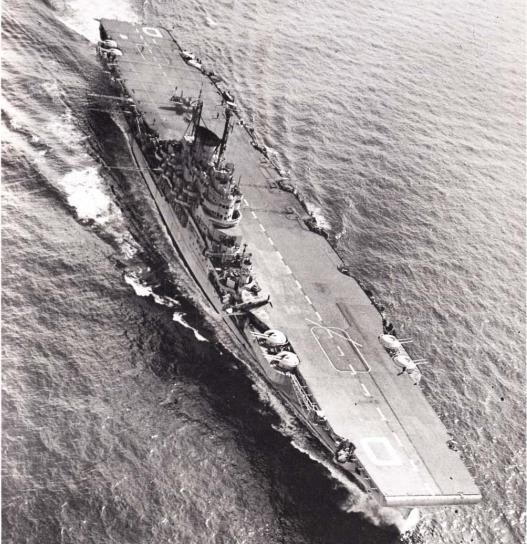
Below, HMS Victorious (R38) sailing on the Atlantic in 1965.

Specifications (after rebuild)

Type: aircraft carrier

Displacement: 30,530 tons; 35,500 tons (full-loaded)

Length: 38 m (781 feet)

Beam: 47.8 m (157 feet)

Draft: 9.5 m (31 feet)

Propulsion: 3 Parsons steam geared turbines, with 3 shafts, supplied by 6 boilers, generating 110,000 SHP.

Speed: 31 knots

Range: 11,000 nautical miles (20,000 km)

Compliment: 2,400 sailors and officers.

Aircraft: Fairey Swordfish, Fulmar, Avenger, F4F Wildcat, and F4U Corsair aircraft during WWII.

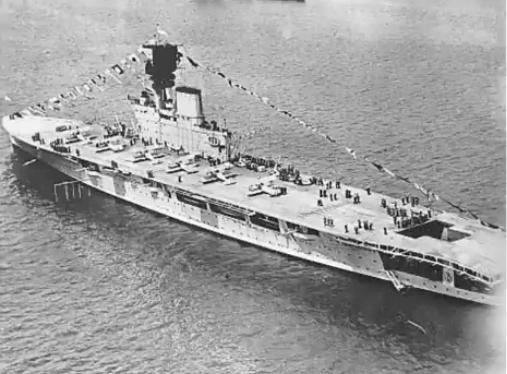
Below, HMS Victorious in 1941, a couple of weeks before it was commissioned.

The bow of the British aircraft carrier in 1944. The noses of two Fairey Fulmars and one Albacore can be seen on the deck.

Below, HMS Victorious in 1943, operating with the US Navy.

The fully modernized British carrier turning to starboard in 1960.


HMS Illustrious (87)

HMS Illustrious (87) was a British aircraft carrier used by the Royal Navy during World War II. She carried out combat missions in the Mediterranean, the Indian, and the Pacific Theater of Operations. Sailing the waters of the Mediterranean Sea, HMS Illustrious played a key role in the Battle of Taranto, in 1940, when the Fairey Swordfish torpedo bombers took off from her deck and attacked the Italian fleet moored at their naval base of Taranto. As a result, several Italian ships were sunk and seriously damaged. During this armed conflict, she would win five awards and honors. She was the lead ship of her class, which also included HMS Victorious (38) and HMS Formidable (67).

HMS Illustrious (87) was designed at the end of 1936, when the British Admiralty invited bids for the construction of two aircraft carriers. Vickers Armstrongs' bid were accepted, with a £ 2,395,000 budget/cost. She was laid down on April 27, 1937, at Barrow shipyard, England. She would be launched two years later, on April 5, 1939, and commissioned on May 25, 1940. Because of the war, Illustrious' flying trials were the shortest on record. She was assigned to the Mediterranean Fleet, sailing for the island of Malta with 21 Fairey Swordfish torpedo bombers, 7 Fairey Fulmar reconnaissance/fighters, and 5 Blackburn Skua dive-bombers.

Technical Characteristics

HMS Illustrious (87) was the first aircraft carrier in any navy to be built with an armored hangar, which granted it greatly increased protection against air attacks. However, the weight of the armor allowed the ship to have only one hangar. The flight deck was originally 620 ft (189 m) long, but later it would be increased to 740 ft (226 m), while the width was 95 ft (29 m). The flight deck was served by two elevators. The fact that it was strongly armored allowed her to survive eight bombs when she was attacked off Crete on January 10, 1941. One catapult was fitted on the port side of flight deck, which had a double-reeved arresting wire across it.

At the island, the bridge was reinforced with bullet-proof plates to protect the officers against enemy aircraft strafe. The main armored deck, protecting ammunition, machinery, and fuel stowage, was 3-inch (75-mm) thick. The main belt protecting the carrier consisted of 4 1/2-inch (115-mm)-thick welded steel plates. The main mast of the island was fitted with a Type 281 aerial radar, while the ship's power plant consisted of three Parsons geared steam turbines, with three shafts, supplied by six boilers. The air group was originally composed of 33 aircraft, but, by 1944, the number of combat aircraft had been increased to 52.

Specifications

Displacement: 23,000 tons (29,240 tons full-loaded)

Length: 740 feet (226 m)

Beam: 95 feet (29 m)

Draft: 28 feet, 10 inches (8.7 m )

Propulsion: 3 Parsons geared steam turbines, 3 shafts, and 6 boilers, generating 110,000 SHP.

Maximum Speed: 30.5 knots

Armament: sixteen 114-mm AA and forty eight 2-pdr AA guns.

Aircraft: 52 (33 originally). In the Pacific, she carried 20 F4U Corsairs and 16 Avengers.

Compliment: originally 1,229 sailors an officers; 1,997 by 1944.

Below, the HMS Illustrious sailing on the Atlantic in June 1940, right before being assigned to the Mediterranean Fleet.

The Illustrious in 1946, after the war. By then, her hull had been remade at her extremities as the flight deck had been lengthened, with the forward run-down completely re-shaped.

Below, the mighty British aircraft in July 1939, during trials.

The coat of arms of the Illustrious.


USS Lexington (CV-2)

USS Lexington (CV-2) was the second aircraft carrier in service with the US Navy, being preceded by USS Langley (CV-1). She had originally been designed as a battlecruiser in 1916 and converted into a carrier, along with her sister ship USS Saratoga (CV-3), in 1922. Despite being a conversion, she could carry up to 68 combat aircraft. During WW2, she had aboard 21 Brewster F2A Buffalo fighters, 32 Douglas SBD Dauntless dive bombers, and 15 TBD Devastator torpedo bombers.

USS Lexington (CV-2) was away at sea, carrying aircraft to Midway, when the Japanese attacked the US Navy's base of Pearl Harbor on December 7, 1941. At the end of December, 1941, as part of Task Force 11, she besieged the Wake Island (Marshall Islands) as her aircraft attacked the Japanese military installations there, wreaking havoc. The following year, she would take part in the Battle of the Coral Sea in early May 1942. During this naval encounter against the Imperial Japanese Navy, her bombers hit and damaged IJN Shokaku aircraft carrier. However, on May 8, 1942, during this battle, she was seriously damaged by enemy aircraft and she had to be scuttled on the same day.

Technical Characteristics

Laid down for conversion on January 8, 1921, US Lexington was commissioned as an aircraft carrier on December 14, 1927. She had a starboard island, with an integral funnel, a straight-through flight deck, and transverse arrester wires. The former battlecruiser hull had been carried up to the hanger deck. The hangar deck itself was completely enclosed within the hull. Unusually for an USS carrier, the bow and stern were faired (joined smoothly) into the hull.

The most noticeable feature of the USS Lexington (CV-2) was the huge smoke stack (funnel) on her starboard side. It was located aft and separate from the island, which was small and contained navigation facilities. The turbo-electric machinery was the most powerful of the US Navy when WW2 broke out, enabling the ship to sail at the top speed of 34 knots.

Specifications

Type: aircraft carrier

Displacement: 37,681 tons; 43,005 tons (full-loaded)

Length: 270.7 m (888 feet)

Beam: 32.1 m (105 feet)

Draft: 10.2 m (33 feet, 4 inches)

Propulsion: 4 sets of General Electric turbines, with 4 shafts, and 16 water-tube boilers, generating 180,000 SHP.

Maximum Speed: 34 knots

Range: 10,500 nautical miles cruising at 15 knots.

Armament: eight 203-mm naval guns; twelve 127-mm AA guns.

Compliment: 2,327 sailors and officers.

Below, profile view of the USS Lexington off the coast of Hawaii in 1932.

The CV-2 aircraft carrier cruising along in the Pacific circa 1939.

Below, aerial view of the US Navy's first three carriers around 1930; the USS Langley (CV-1) in the foreground; next, in the middle, the USS Saratoga (CV-3); and USS Lexington (CV-3) in the background.

The USS Lexington in flames after being hit by Japanese dive bombers on May 8, 1942.


HMS Hermes (95) Royal Navy Carrier

HMS Hermes (95) was a Royal Navy's aircraft carrier, which was in service between 1924 and 1942. She was the first aircraft carrier with a flush deck originally designed as such. However, the number of combat airplanes she could carry was limited to twenty. The first type of aircraft she carried on her first assignment was the Fairey Flycatcher, which was a carrier-based fighter biplane. In those days, the carrier was not considered to be an important war vessel. It was the battleship, which given priority in military naval construction. However, WW2 would prove otherwise.

The design and construction of the HMS Hermes (95) had been ordered in 1917. She was laid down in early 1918 and built by Armstrong Whitworth on the shipyards on the bank of the River Tyne. She was launched on September 11, 1919. After the sea trials, she was commissioned on February 18, 1924. Her first assigned to the Mediterranean Fleet based at Malta. In 1925, she would be sent to Hong Kong. Later, she would return to the Mediterranean Sea.

During the 1930s, HMS Hermes spent most of her time in the Far East. With Hong Kong being her base of operations, she would often sail to visit other ports, such as Shanghai, Manila, and Singapore. When World War II broke out, she had already returned to Home port for refit. In August, 1939, she had been equipped with twelve Fairey Swordfish torpedo-bomber. In September, after Great Britain had declared war on Germany, she carried out anti-submarine patrol missions. Hermes was operating in the Indian Ocean when, on April 9, 1942, she was attacked by approximately 50 Japanese dive-bombers. Hit hard, she would sink after several hours. At the time of the attack, she did not have any combat aircraft aboard to defend herself with.

Technical Description

HMS Hermes (95) had a 182-m long flight deck and a large island on the forward portion and starboard side of ship. The island included both the bridge and funnel. It had a sturdy tripod mast, with a large fighting top. Although the island was unusually long, it was very narrow. She was powered by two Parsons geared steam turbines, with two shafts and supplied by six boilers; this propulsion system generated 40,000 shaft horsepower (SHP).

To maximize the size of her flight deck, the hull was built with considerable flare. Thus, she proved to be an excellent sea boat. Despite her size, HMS Hermes was able to carry only 20 aircraft. Like other carriers of the time, she was fitted with longitudinal wires first; however these were replaced by transverse arrester wires in the early 1930s.

Specifications

Type: aircraft carrier 

Displacement: 13,000 tons (full loaded); 10, 850 tons (standard)

Length: 182.3 m (598 feet)

Beam:  21.4 m (70.3 feet)

Draft: 5.7 m (18.5 feet)

Propulsion: two Parsons geared steam turbines, with two shafts, and six boilers.

Maximum Speed: 25 knots

Range: 5,600 nautical miles (10,400 km)

Aircraft: 20

Armament: ten 152-mm and four 102-mm AA guns.

Crew: 664 sailors and officers.

Below, historical pictures of HMS Hermes (95) in the 1930s and during WW2 when she was hit and sunk.


HMS Courageous (50)

HMS Courageous (50) was an aircraft carrier in service with the Royal Navy between 1928 to 1939. She had begun her career as a light battlecruiser in 1916, taking part in naval engagements of the First World War. However, in 1924,  the British government decided to convert it into an aircraft carrier, along with two other battlecruisers that had also fought in this armed conflict; HMS Glorious and Furious. The main reason for the conversion of these surface warships was the Washington Naval Treaty of 1922, which had turned them into WW1 leftover, floating junk, as this treaty limited the fleet tonnage of the signatory countries.

During the First World War, three light battlecruisers had been built; HMS Courageous, HMS Furious, and HMS Glorious, each with four 380-mm (15-in) guns, serving with the British Grand Fleet. After the war, all three warships were put in reserve until they were converted into aircraft carriers, whose transformation would begin in 1924. In early May, 1928, Courageous was commissioned after several months of sea trials. Not only were they fitted with a flight deck and storage hangars for their aircraft, but their propulsion system was also upgraded, being fitted with four Parsons geared steam turbines, with four shafts.

As soon as she was commissioned, HMS Courageous (50) was assigned to the Mediterranean Fleet, which was based at Malta, where she would spend two years. From 1930 to 1938, she served with the Atlantic and Home Fleet. In 1934, she was equipped with hydraulic catapults on the upper flight deck, which was 240-m (787 ft) long. What made her look different from other carriers was her small island, which was located on the starboard side and on the forward portion of ship. Also, the flight deck did not cover the whole length of the former battlecruiser hull, whose aft section stuck out below it.

Although she rendered a good service in the inter-war years, HMS Courageous was sunk early in the war. On September 17, 1939, she was struck by two torpedoes launched by the German submarine U-29, while she was conducting anti-submarine operations in the Atlantic, off the coast of Ireland, along with two British destroyers. Several hours later, she sank into the bottom of the Atlantic. Due to the Fairey Swordfish torpedo-bombers she carried onboard, it was common for her to carry out anti-submarine missions. She was the first British warship to be sunk in World War II.

Specifications

Type: fleet aircraft carrier

Displacement: 27,560 tons (full load)

Length: 240 m (787 ft)

Beam: 27.6 m (90 ft)

Draft: 8.5 m (28 ft)

Power Plant: 4 Parsons geared steam turbines, with four shafts, supplied by 18 Yarrow tube boilers, producing 90,000 SHP.

Maximum Speed: 30 knots

Range: 6,500 nautical miles.

Aircraft: 48

Crew: 1,216 men

Below, aerial view of the HMS Courageous (50) before the war, in 1937.


Popular Posts