Showing posts with label Submarines. Show all posts

Japanese Submarine I-58

The Japanese submarine I-58 was the IJN submersible vessel that torpedoed and sank the American cruiser USS Indianapolis on July 30, 1945, at the end of World War II. She belonged to the B3 Type class of cruiser submarines, the first of which, the I-54, had been launched in May 1943. The I-58 was launched on October 9, 1943, and she was commissioned for service with the Imperial Japanese Navy on September 7, 1944. She was armed with four Kaiten and fourteen Type-95 torpedoes that were fired through 533-mm tubes. The Type-95 was a conventional torpedo fitted with a 405-kg warhead, while the Kaiten was a manned, kamikaze torpedo, which was used by every Japanese sub at the end of this armed conflict.

The I-58 submarine had been laid down on December 26, 1942 at the Yokosuka Naval Arsenal, and launched on October 9, 1943. During the construction of the boat, her 14 cm/40 11th Year Type naval gun was removed to make room for the four Kaiten manned kamikaze torpedoes. The submarine was finally completed on September 7, 1944; Lieutenant Mochitsura Hashimoto was appointed commander of this Japanese boat. After intensive training, the I-58 was assigned to the 15th Submarine Division on December 4, 1944. A few days later she was assigned to the Kongo ("Diamond") group, with I-36, I-47, I-48, I-53 and I-56, to attack five US fleet anchorages with Kaiten torpedoes.

After the American invasion of Iwo Jima in February 1945, I-58 and I-36 joined the Shimbu group which was formed to counterattack American forces, but they did not succeed. On July 30, 1945, I-58 sank USS Indianapolis (CA-35) with three Type 95 torpedoes, with about 40% of the surviving crew being eaten by sharks. Because the cruiser was not zig-zagging, her captain was held accountable for the ship's loss. With the help of I-58's skipper, his name was finally cleared in 2000. Thus, she was a prime player in one of the most controversial episodes in US naval history. I-58 survived the war only to be scuttled in April 1946.

Specifications

Type: B3 Type cruiser submarine

Displacement: 2,607 tons (surfaced); 2,365 tons (submerged)

Length: 108.7 m

Beam: 9.3 m

Draft: 5.2 m

Propulsion System: two 4,700-sHP diesel engines, driving two shafts; two 1,200-HP electric motors.

Maximum Speed: 17.75 knots (surfaced); 6.5 knots (submerged)

Range: 21,000 nautical miles

Crew: 94

Armament: six 533-mm launching tubes, with 14 Type-95 torpedoes, and four Kaitens.

Above, the IJN submarine I-58 in late 1943.

Lt. M. Hashimoto, the commander of the I-58.

Suffren class submarine

A Suffren class submarine is one of a series of nuclear attack boats in service with the French Navy since 2020. She is extremely stealthy and she carries inside a wide array of weapons, which include anti-ship and anti-submarine torpedoes as well as anti-ship and land-attack cruise missiles. She was designed for open sea operations to sneak through enemy fleet without being detected, with its nuclear propulsion system enabling it to carry out long-range missions. The Suffren will replace the Rubis class boats, which had been designed and developed during the Cold War.

With a total of six submarines having been planned, the first of the class, the Suffren S635, was laid down in December 2007 and launched on July 12, 2019, being commissioned with the French Navy on November 6, 2020. The Duguay-Trouin S636 was launched in September 2022 and commissioned in July 2023. The Tourville S637 entered service in November 2024. Meanwhile the De Grasse S638 has already been launched and is undergoing sea trials. The remainder two subs have been laid down and are being built by the French firm Naval Group at the Cherbourg-en-Contentin's shipyards.

Technical Characteristics

The Suffren class submarine is the largest attack submarine in Europe (with the exception of the Russian ones), with a hull length of almost 100 m and a hull diameter of 8.8 m. Her pump-jet propulsion system, her internal vibration absorbing materials, and the hull low magnetic signature make the Suffren boat one of the stealthiest in the world. The submarine is powered by one K15 nuclear reactor, which generates 150 MW. Aside from its anti-ship, anti-submarine, and land-attack warfare capabilities, the Suffren class is equipped with an advanced electronic system to carry out intelligence gathering operations while operating in enemy coastal regions.

Specifications

Type: nuclear-powered attack submarine

Displacement: 5,300 tons (submerged); 4,770 tons (on surface).

Length: 99.5 m (326 feet, 5 inches)

Beam: 8.8 m (28 feet, 10 inches)

Draft: 7.3 m (23 feet, 11 inches)

Propulsion: one K15 nuclear reactor, with two turbogenerator groups; two emergency diesel generators; one electrically-driven pump-jet propulsion system.

Maximum Speed: 28 knots

Range: unlimited

Endurance: until the food supply runs out.

Compliment: 60 men

Armament: four 533-mm torpedo tubes, with F21 Artemis heavyweight torpedoes; Exocet SM39 anti-ship missiles; sub-launched Storm Shadow cruise missiles; anti-ship naval mines.

The Suffren S635 cruising in the North Atlantic in 2023.

The Duguay-Trouin during sea trials in the Mediterranean.

Borei-Class Submarine

A Borei-class submarine (Project 955) is one of a batch of eight nuclear ballistic missile submarines in service with the Russian Navy since 2012. A total of fourteen boats were planned for the series. As of December 2025, three subs are still being built and the last three ones are projected to be laid down at Sevmash' shipyards in the next couple of years. One of her main advantages is stealth as they sail by in the deep waters of the world's oceans practically undetectable, moving surreptitiously along a coastline or under an enemy fleet without being discovered. She was designed by Rubin in the late 1980s to replace the Typhoon and Delta IV class.

Technical Characteristics

The Borei-class submarine is the largest boat in the world today, with 170 m in length and 13.5 m in width (beam). The hull is sleek and streamlined to reduce the broadband noise. Although it is not mentioned in any defense industry magazine and website, the Project 955 boat was built with a two-layer hull made of titanium, which reduces sharply her magnetic signature. This double hull structure is based on the Alfa-class and Sierra II submarines of the Cold War period. Her external hull is shrouded in a sound-absorbing rubber layer, which is known as anechoic plating.

The use of titanium to build a submarine hull is extremely expensive for NATO nations but not for Russia, which is the main producer of this metal and the only country in the world which has the technology and the skilled hands to weld together the different titanium hull sections. Both the Project 955 and 955A versions feature a buoyant rescue chamber, large enough for the whole crew. The Borei submarines are equipped with a pump-jet propulsion system, like the one fitted in the Khabarovsk class subs. These boats are armed with 16 RSM-56 Bulava ballistic missiles and fitted with eight 533-mm torpedo tubes.

Active Submarines of Borei Class

Yury Dolgorukiy (K-535); Alexandr Nevsky (K-550); Vladimir Monomakh (K-551); Knyaz Vladimir (K-549); Knyaz Oleg (K-552); Generalissimus Suvorov (K-553); Emperator Alexandr III (K-554); Knyaz Pozharskiy (K-555); Dmitry Donskoy (K-556).

Specifications

Type: nuclear-powered ballistic submarine

Displacement: 24,000 tons (submerged); 14,720 tons (on surface)

Length: 170 m (557 feet, 9 inches)

Beam: 13.5 m (44 feet, 3 inches)

Draft: 10 m (32 feet, 10 inches)

Propulsion: one OK-650V nuclear reactor, with one steam turbine and one pump-jet.

Maximum Speed: 30 knots (submerged); 15 knots (on surface).

Range: unlimited; she must dock at base for food supply.

Compliment: 107 sailors and officers

Armament: sixteen RSM-56 Bulava SLBM; seven RPK-2 Vyuga anti-submarine/ship missiles; eight 533-mm torpedo tubes.

Above, the Borei-class Alexandr III (K554) moored at dock

Alexandr Nevsky (K-550) during trials.

Dmitry Donskoy docked at base on the Kola Peninsula.

Khabarovsk Class Submarine

A Khabarovsk class submarine (Project 09851) is one of a series of five nuclear-powered attack submarines, which will be in service with the Russian Navy in the next couple of years. The first and lead sub of this class was named after the Russian city of Khabarovsk. She was launched on November 1, 2025. She has the same configuration of a Borei class submarine, from which she was developed. However, with a 137-m-long hull, the Khabarovsk class sub is smaller than a Borei boat, which is 160-m in length. The reason for this is that the latter one is a ballistic missile submarine, and the former an attack underwater vessel.

The Khabarovsk class submarine is perhaps, together with the Yasen class, the most advanced and stealthiest attack submarine in the world today. These are the main characteristics that make this boat class a cutting-edge underwater weapon: the vessel features a traditional titanium double-hull structure; it’s not just a submarine; it is the first-ever vessel specially designed to carry the Poseidon underwater drone, which is a nuclear-capable autonomous vehicle that can strike distant targets with unprecedented stealth. Each one of these submarines will be able to carry six or more Poseidons (some sources suggest up to 12) for deep‑sea, long‑range missions. Aside from the Poseidon, the Khabarovsk is armed with fast powerful torpedoes and is equipped with vertical launch tubes for cruise missiles in anti‑ship/land‑attack missions.

"Today is a significant event for us – the heavy nuclear-powered attack submarine Khabarovsk is being launched from the renowned Sevmash shipyard," Defence Minister Andrei Belousov said after Navy Commander Admiral Aleksandr Moiseev smashed the traditional bottle of champagne into the hull of submarine. The Defence Ministry confirms on Telegram that the new submarine will carry robotic weapons systems "for various purposes."

Specifications

Type: nuclear attack submarine

Builder: Sevmash

Displacement: 14,000 tons (submerged)

Length: 137 m

Beam: 12 m

Draft: 7 m

Propulsion: one OK-650V nuclear fission reactor; one steam turbine; one pump-jet.

Maximum Speed: 35 knots (submerged)

Range: 27 years (she must moor at base for food and water supply).

Compliment: 114 men

Armament: 10 Poseidon underwater vehicles; anti-ship and land-attack missiles; 533-mm torpedo tubes.

Above, the first Khabarovsk class submarine, which was launched on November 1, 2025.

The aft portion of the new attack submarine. The tail is shrouded for security reason. It uses a pump-jet propulsion system.

Trafalgar Class Submarine

A Trafalgar class submarine was one of a series of seven nuclear-powered boats in service with the British Royal Navy between 1981 and 2009. They were all developed and built by Vickers Ship Building firm at the shipyards in Barrow-in-Furness. The first submarine of the class to be laid down was HMS Trafalgar (S107), which was launched on July 1, 1981. She would be commissioned in 1983. The other boats were the HMS Turbulent (1984), Tireless (1985), Torbay (1987), Trenchant (1988), Talent (1989), and HMS Triumph (1991). All seven boats were armed with Tomahawk cruise missiles and with wire-guided, homing Tigerfish torpedoes.

Technical Description

The Trafalgar class submarine was a medium-size fleet boat (attack submarine), with a crew of 130 sailors and officers. It was built with a single hull made of steel, with a low magnetic signature, and it was powered by one Rolls-Royce pressurized-water nuclear reactor, with two steam turbines and two generators. This class was fitted with anechoic tiles on the outer surface of hull to deaden the sound waves of enemy active sonars, sharply reducing the return signal and also to insulate the submarine inner vibrations produced by machinery. You must remember that noise is the main source of submarine detection. Thus, this class was much quieter than their predecessors, the submarines of the Swiftsure class.

Specifications

Type: nuclear attack submarine

Displacement: 5,208 tons (submerged); 4,700 (surfaced)

Length: 85.4 m (280 feet)

Beam: 9.8 m (32 feet)

Draft: 9.5 m (31 feet)

Propulsion: one Rolls-Royce PWR1 nuclear reactor; two GEC geared steam turbines; two Westing House Allen turbo generators; two diesel generators, with a total 18,000 SHP generation.

Maximum Speed: 30 knots (56 km/h) submerged.

Range: unlimited; food supplies holds out 85 days.

Compliment: 130 men

Weapons: five 533-mm (21-inch) torpedo tubes, with 30 torpedoes; Tomahawk Block IV cruise missiles.

Above: the launch of HMS Trafalgar (S107). The angular metal cover on her bows is a security measure to conceal the torpedoes exits.

The Trafalgar Class Submarine HMS Trenchant (S91) sailing in the North Atlantic in the late 1980s.

HMS Torbay.

USS Nautilus (SSN-571)

The USS Nautilus (SSN-571) was the first nuclear submarine in service with the US Navy. It was also the first nuclear-powered ship in the world. She was launched on January 21, 1954 and it was commissioned the same year, on September 30, 1954. Although she was not a stealthy boat and she lacked today's powerful sonar, the nuclear reactor gave the Nautilus an unlimited range as she only had to stop and moor at port for food supply. Built by Electric Boat (General Dynamics) at Groton, Connecticut, the ship is now on permanent display at the Nautilus Memorial and Submarine Force Library and Museum, Groton, CT.

The USS Nautilus was a big submarine. It had three decks and plenty of internal space compared with the conventional fleet submarines. Aside from its ability to stay completely submerged nearly indefinitely, it was also fast. It was able to sail at 23 knots, while remaining completely submerged for months. Her unlimited range enabled the Nautilus to be the first submarine to sail underwater under the icecap of the Arctic, traversing it completely.

Propulsion

The USS Nautilus' propulsion system consisted of a Westinghouse S2W pressurized water reactor. The water heated by this reactor was used to produce steam, which drove the main and secondary turbine. The main turbine drove the reduction gear, which in turn drove the propeller shaft. The secondary turbine drove the AC generator, which produced electricity for the entire boat.

Specifications

Type: nuclear-powered attack submarine

Displacement: 4,092 tons (submerged); 3,533 tons (surface)

Length: 98 m (320 feet)

Beam: 8.5 m (28 feet)

Draft: 7.9 m (26 feet)

Propulsion: Westinghouse S2W nuclear reactor, with one shaft.

Maximum Speed: 23 knots (43 km/h)

Compliment: 92 sailors, 13 officers.

Armament: 6 torpedo tubes.

The USS Nautilus (SSN-571) - footage


The USS Nautilus sailing in the Pacific in 1958

Project 945A Kondor

The Project 945A Kondor is a class of Russian nuclear attack submarine, which was developed by the Soviet Union during the Cold War. Known as Sierra II in the West, it is one of the fastest boat in service in the world today. It is characterized by a wide variety of lethal armament, ranging from supersonic anti-ship missiles to powerful torpedoes which can sink any type of surface vessel and enemy submarine. Although the submarines of this class entered service during the Cold War, they have been upgraded with new powerful sonars, high-tech equipment, and weapons.

The Project 945A Kondor (Sierra II) succeeded the Project 945 Barrakuda class (Sierra I). The first of the four Kondor submarines, the Nizhniy Novgorod, was laid down on February 15, 1989, and it was built by the State-run ship-building plant Krasnoye Sormovo, in Nizhniy Novgorod Oblast, on the Volga River. It was introduced into service in 1990. The four submarines are still in service today (2025) and they are feared by the West for the destructive power they possess as only one boat is enough to destroy a whole NATO nation navy task force formed around an aircraft carrier. They are assigned to the Russian Northern Fleet.

Technical Characteristics

The hull of the Project 945A Kondor submarine is made of two layers of titanium plates. Thus, it is lighter and faster than a conventional steel boat. Since titanium is a non-magnetic metal, it has a very low magnetic signature, which makes it extremely hard for an enemy sonar to detect. Titanium and the use of outer rubberized tiles and rubber pads and washers to absorb vibration make of the Kondor submarine one of the stealthiest in the world.

The Russian Sierra II boat is powered by one pressurized water nuclear reactor, which generates 190 MW (megawatt). This reactor feeds two electrical motors, with one shaft and two spinners. It can travel at the maximum speed of 36 knots (67 km/h) submerged. This means that it is faster than NATO submarines. Aside from its anti-ship and anti-sub missiles, it is armed with the VA-111 Shkval supercavitating torpedo, which is a very fast torpedo that travels at the top speed of 400 km/h (247 mph or 210 knots). This torpedo has a 210-kg HE warhead, capable of sinking super aircraft carrier or a destroyer.

Specifications

Displacement: 9,100 tons (submerged); 7,600 tons (surfaced).

Length: 110 m (360 feet)

Beam: 14.2 m (47 feet)

Draft: 8.8 m (29 feet)

Propulsion: one 190-MW, PWR nuclear reactor; two 1,000-HP motors.

Maximum Speed: 36 knots (67 km/h)

Range: unlimited; food supply for 70 days.

Compliment: 70 sailors and officers

Armament: six 530-mm torpedo tubes, with 24 VA-111 Shkval torpedoes; a large number of P-700 Granit or P-800 Oniks anti-ship cruise missiles, and 3M22 Zircon hypersonic missiles.

Below, the three of the four Sierra II (Project 945A) boats of the Russian Northern Fleet.

A Project 945 Barrakuda submarine (Sierra I), from which the Kondor was developed, in 1987.


First Modern Submarine

The first modern submarine was the German U-boat Type XXI, which was developed between 1943 and 1944. It featured new radical innovations, making it also the first attack submarine. First, it could maneuver and assail enemy ships out of the blue from an entirely submerged position thanks to its high-sustained underwater speed; until then older submarines had to emerge to the surface to be able to launch their torpedoes. Being a fast boat also allowed it to outrun Allied surface warships, due to new turbo-supercharged diesel engines. At the same time, its modern snorkel enabled this Kriegsmarine's submarine to operate entirely submerged.

Second, the first modern submarine (Type XXI) was fitted with six bow torpedo tubes and an electric torpedo reloading system. This feature gave it a much higher rate of fire and the capacity to attack three or more surface ships at the same time. Third, it could also dive much deeper than its predecessors, maneuvering faster as it did so. Thus, it was capable of defeating the Allied surface warships tactics, which had been very successful against the Type VII and Type VIIC boat. It was also equipped with a highly-sensitive passive sonar, which was very advanced for the time.

Right after the World War II, both the United States and the Soviet Union began to design and develop fast attack submarines based on the German Type XXI boat, which had a streamlined hull shape. Ironically, the Germans were able to build this U-boat because Helmuth Walter had already worked on a revolutionary fast attack submarine in the 1930s. The commander of the newly-created Kriegsmarine, Karl Doenitz, supported his project before the war broke out. Walter would also design a futuristic closed-cycle submarine, in which hydrogen peroxide would be used to obtain oxygen for the crew to breathe from carbon monoxide emanating from fuel-burning engines during prolonged, high underwater speeds.

Below, a German Type XXI submarine, the first modern attack submarine.


Soviet Submarines

The number of Soviet submarines in service had never dropped below the 200 underwater vessels since the 1930s until the collapse of the Soviet Union in 1991. The Soviet Navy also laid claim to being among the first of the world´s navies to explore the full potentialities of the ´submarine torpedo boat´. Even before the emergence of the Soviet Union in 1917, the Russian submarine inventions and experiments included the periscope, the torpedo ´drop collar´, a chemical air purification system, and the sectional hull construction for quick disassembly and reassembly.

Looking back over a 75-year period of submarine building, a few traditions stand out. The Soviet Navy habitually operated more different classes and types than did any other navy in the world. By the end of the 1980s, there were as many different operating classes as there are letters in the alphabet. This fact must surely have put a strain on their maintenance and logistics. Another related phenomenon had been the tendency to operate side by side very new and very old submarines.

The third tendency in the Soviet Navy had been the building of specialized or ´mission-specific´ submarines. For example, during the 1930s, the diminutive Malodki class boat, armed with only two torpedoes, was charged with near shore defense, striking enemy surface ships that approached the coasts of the Soviet Union. The medium-size Shchuka, on the other hand, was designed for forward offensive operations.

The functional balance of the Soviet submarine fleet was particular striking during the last two decades of the existence of the Soviet Union. Whereas the United States of America had a tendency to build single classes of multi-purpose attack boats, the Soviet Navy laid down multiple classes to apparently suit different missions and weapon systems. Therefore, the Soviet Union built different types depending on whether the main armament was cruise missiles, torpedoes, or ballistic missiles. Also, the Soviet Union was the first and the only country in the world to build boats with double hull made entirely of titanium. In the missile-carrying category, it produced different classes to fit short versus long-range missiles, with most of them being nuclear-powered boats.

List of the most important Soviet submarine classes during the Cold War

Class

Whiskey (Project 613):  215 were produced, with the first being completed in 1952. These were diesel-electric boats.

November (Project 627): commissioned in 1959, 13 subs were built as they were the first Soviet nuclear-powered submarines.

Foxtrot (Project 641): a total of 41 boats built between 1959 and 1962. They were diesel-electric patrol submarines.

 Juliet (Project 651): 16 were completed. They were diesel-electric, cruise missile submarines, with the first being commissioned in 1963.

Yankee (Project 667): they were 34 nuclear-powered ballistic subs, with the first one commissioned in 1967.

Echo (Project 675): they were 34 nuclear boats armed with anti-ship cruise missiles.

Charlie I, II, III (Project 670): they were nuclear-powered cruise-missile subs, with a total of 33 built between 1967 and 1977.

Victor I, II, and III (Project 671): they constituted a series of 48 nuclear attack submarines, which were built between also between 1967 and 1977.

Alfa (Project 705): 7 nuclear attack submarines, with the first one being commissioned in 1971.

Delta I, II, III, IV (Project 667B): a total of 43 were built between 1981 and 1992. They were nuclear-powered ballistic boats.

Oscar (Project 949): they were 14 nuclear-powered cruise-missile submarines.

Typhoon (Project 941 Akula): they were 6 nuclear ballistic-missile boats.

Below, a November class submarine, which was the first Soviet sub being powered by a nuclear reactor.


Alfa-Class Submarine

The Alfa-class submarine (Project 705 Lira) was one of a series of 7 nuclear attack submarines in service with the Soviet Navy during the Cold War. With a streamlined hull entirely made of titanium, she was the fastest boat in the world, with a test depth of +400 m (1,300 feet). She was also characterized by stealth and her powerful sonar which could detect and track enemy vessels from a long distance. She featured a new type of sail design, which neatly blended into the hull to minimize water flow disturbance. All seven subs were assigned to the Soviet Navy's Northern Fleet, which operated through and from the Arctic Ocean, under the ice cap, secretly cruising into the Atlantic and Pacific Ocean.

The first Alfa-class submarine, K-64, was laid down on June 2, 1968. Being built on Sudomekh shipyards, in Leningrad (Saint Petersburg), she was launched on April 22, 1969, and commissioned on December 31, 1971. The last submarine of Project 705 Lira to be completed was K-463, which was commissioned in 1981; and the last boat of the series to be decommissioned was K-123, which was struck (phased out) on July 31, 1996; she had entered service with the Soviet Navy in 1977. They were all based on the Kola Peninsula, between the White Sea and the Barents Sea.

Like their American counterparts, the Project 705 submarines were never used in combat. However, they proved to be one of the most reliable Soviet subs of the Cold War period in terms of fire power and stealth. Not only did they represent a big shock and surprise to the US Government when they discovered their existence, but also a great threat to the US Navy's carriers. Only one of them, the K-64, had an initial technical problem with her first nuclear reactor, when the liquid metal in the primary coolant hardened. Thus, for safety reasons, she would be taken out of service in 1974, while the remaining six boats would keep sailing the seas flawlessly.

Technical Characteristics

Designed by Mikhail Rusanov, the Alfa-class submarine was a high-speed, nuclear-powered boat, which had been conceived to seek out and destroy NATO's submarines and aircraft carriers. She was powered by one BM-40A liquid-metal-cooled nuclear reactor, which generated 155 MW (megawatts). Using rods of uranium-235, it was a modular, two-section reactor, with two steam lines and circulating pumps. It produced pressurized steam to drive two turbines, which turned the generators. Submerged, she could move at the maximum speed of 41 knots, that is to say, 76 km/h (47 mph).

The hull of the Project 705 Lira submarine was of the double-hull design type. Both the inner and outer hull were made of titanium. This configuration and the material employed had already been used before to build the Project 627 (November-class) submarines. Titanium had the advantage of lowering the hull magnetic field, while the internal hull had an internal coating, which was designed to absorb own-ship machinery noise and reduce the acoustic signature of the submarine.

The Alfa-class submarine consisted of six compartments. Right above the control compartment, there was an escape chamber in the sail, which could accommodate the entire crew of 31 officers. In an emergency situation, the crew could enter the chamber through a hatch in the submarine. The chamber could be released and then float up to the surface through buoyancy and wait for rescue.

Specifications

Type: nuclear attack submarine

Displacement: 3,220 tons (submerged); 2,324 tons (surfaced)

Length: 81.4 m (267 feet)

Beam: 9.5 m (31 feet, 2 inches)

Draft: 7.1 m (23 feet, 3 inches)

Propulsion: one  BM-40A nuclear reactor, one 40,000-SHP steam turbine, and one shaft.

Maximum Speed: 41 knots (submerged); 12 knots (surfaced)

Range: sailing indefinitely for 20 years, but limited to 60 days for food and logistically supply.

Armament: six 533-mm torpedo tubes, with twenty VA-111 Shkval supercavitating torpedoes and eighteen 53-65K conventional torpedoes; 24 mines.

Below, an Alfa-class submarine on a naval base on the northern coast of Russia.


Five of the seven operational Project 705 Lira submarines moored at Zapadnaya, Litsa, naval base on the Kola Peninsula.

A Project 705 sub cruising on the surface in the northern Atlantic. You can notice how her sail blends into the hull. The masts could be retracted fully and covered over.

Below, an Alfa-class submarine photographed in the Barents Sea in the Summer of 1983. She had clean lines, revealing her underwater speed potential.

The Project 705 boat on dry dock for maintenance.


USS Grouper (SS-214)

USS Grouper (SS-214) was an American submarine used by the US Navy in the Pacific Theater of Operation of World War II. She belonged to the Gato class, which was composed of 77 attack submarines. Having an extensive and long career, she survived the war and, in 1950, she would be upgraded and converted into a hunter-killer submarine, which was fitted with a new powerful sonar. She was given the new classification number SSK-214. This new type of boats was highly-specialized to search for, track, and destroy enemy submarines. She was decommissioned on December 2, 1968.

Built by the Electric Boat Company, in Groton, Connecticut, USS Grouper was laid down on December 28, 1940, and launched on October 26, 1941. After more than three months of sea trials, she was commissioned into service with the US Navy on February 12, 1942. Her first assignment was the Pacific Submarine Force, which she joined on March 30, 1942. That year, in early June, she patrolled the waters near and around US Navy's Task Force 16 during the Battle of Midway. On February 12, 1943, she sank a Japanese destroyer near the Solomon Islands and, couple of days later, two merchant ships.

In July 1943, USS Grouper (SS-214) was damaged by two depth charges dropped by an America B-25 Mitchel, which mistook her for a Japanese submarine. Thus, she ended her patrols due to damage and headed for Brisbane, Australia, for repairs. On June 24, 1944, she attacked and sank the merchant ship Kumanoyama Maru, which was her last kill of that armed conflict. On April 6, 1945, after her last patrol of the war, USS Grouper sailed to Pearl Harbor.

Specifications

Type: attack submarine

Displacement: 2,415 tons (submerged); 1,525 tons (surfaced)

Length: 95 m (311 feet, 9 inches)

Beam: 8.31 m (27 feet, 3 inches)

Draft: 4.65 m (15 feet, 25 inches)

Propulsion: diesel-electric, with four General Motors Model 16-248, 16-cylinder, diesel engines, four electric motors, and two shafts, generating 2,740 SHP.

Compliment: 80 sailors and officers

Armament: twenty-four Mark-14 torpedoes launched from ten 533-mm (21-inch) torpedo tubes; one 76-mm deck gun.

Below, USS Grouper on January 24, 1942, about two weeks before she was commissioned. Notice the 214 number painted on the tower and bow hull.

Grouper sailing off the coast of a Pacific island in 1944.


USS Tullibee (SSN-597)

The USS Tullibee (SSN-597) was a nuclear attack submarine, which was in service with the US Navy from 1960 to 1988. Characterized by stealth and her small size, she was called the 'Hunter Killer', whose main mission in the Cold War was to stalk Soviet submarines cruising the world oceans. The US Navy built only one boat of this design. Although it could be lethal to enemy submarines, operationally it had a major shortcoming; it was slow (only 16 knots) for Ocean transits.

The project of the Tullibee had begun in 1957, when the need for a small, low-cost submarine with unlimited range arose. The boat was laid down in 1958 and launched on April 27, 1960. After a short period of sea trials, she was commissioned on November 9, 1960. Her crew numbered six officers and fifty enlisted men. Her first skipper was Commander Richard E. Jortberg. The building of additional boat of this type would not be undertaken as the US Navy would come to the conclusion that it was more sensible to produce more Thresher class submarines, because these were more versatile and faster.

Technical Characteristics

The USS Tullibee (SSN-597) was a small and compact submarine. She was only 83 m (273 ft) in length and her displacement was 2,255 tons. Her hull was built with HTS (High Tensile Steel) and not with the higher quality steel HY-80 used in other subs; this technical detail limited her test depth to 215 m (700 feet). She was powered by one S2C pressurized water reactor, which supplied a turbo-electric drive with a single propeller shaft. This reactor was way smaller than the S5W employed in the Thresher class subs.

The Tullibee was equipped with one AN/BQQ-1 sonar system as well as four angled torpedo tubes. The BQQ-1 was the US Navy's first integrated sonar system, which was consisted of the AN/BQR-7 low-frequency, passive array sonar and the AN/BQS-6 spherical active sonar. The BQR-7 was composed in turn of a triple row of hydrophones. This equipment was mounted in the hull of submarine.

Specifications

Type: nuclear attack submarine.

Displacement: 2,255 tons (surfaced); 2,600 tons (submerged).

Length: 83.16 m (273 ft)

Beam: 7.19 m (23 ft, 7 in)

Draft: 6.4 m (21 ft)

Power Plant: one S2C nuclear reactor; one electric motor, driving one propeller shaft.

Maximum Speed: 16 knots (submerged); 13 knots (surfaced).

Range: unlimited (needed to be resupplied with food every other 70 days).

Crew: 56 sailors and officers.

Armament: four 533-mm torpedo tubes.

Below, the SSN-597 Tullibee cruising in the Pacific Ocean in early October 1960 during sea trials. Notice the two dorsal fins, one forward and the other aft, which were part of her PUFFS fire control system.


USS Thresher (SSN-593)

The USS Thresher (SSN-593) was an American fast attack submarine, which was powered by one S5W nuclear reactor. She sank by implosion during deep-diving tests on April 10, 1963, off the coast of Massachusetts, killing 129 officers and sailors. Extremely quiet, she had been designed to hunt Soviet submarines during the Cold War.

The USS Thresher had been launched on July 9, 1960, and commissioned on August 3, 1961. Built at Portsmouth Naval Shipyard, she was the lead submarine of her class of 14 boats. The other subs were Permit (SSN-594), Plunger (SSN-595), Barb (SSN-596), Pollack (SSN-603), Haddo (SSN-604), Guardfish (SSN-612), Flasher (SSN-613), Greenling (SSN-614), Gato (SSN-615), Haddock (SSN-621).

Below, the Thresher on sea trials in July 1961. It had a better hardened hull against explosive shock and introduced new sensors.


Technical Description

The design of USS Thresher (SSN-593) featured major advantages in five vital areas: depth, quieting, sonar, shock hardening, and weapons. She had a greater operating depth than her predecessors of the Skipjack class. Her pressure hull was made of HY-80 steel. Although it was the same type of steel used to produce the Skipjack submarines, to build the Thresher, the American engineers used improved welding techniques and piping, giving her a test depth of 400 m (700 feet).

To reduce the coolant piping and turbine noises, the sub machinery was isolated from the hull using a technique called "rafting", which the Royal Navy had developed for the Ton-class minesweeper. This arrangement decreased the sound transmission through the hull into the sea water. Thus, the twin steam turbines and related gearing were set up on a sound-isolating raft, not directly attached to the hull.

The most advanced electronic feature of the USS Thresher was her AN/BQQ-2 sonar system, which replaced the old BQR-2 and BQR-4 passive sonars. The BQQ-2 revolved around a 15-foot diameter sphere which was fitted with 1,241 hydrophones. Thus, it was capable of greater passive detection than older types of sonars as it could distinguish target noise from own ship and background sea noises. It also had an active acoustic pinging component.

Specifications

Type: attack nuclear submarine

Displacement: 4,369 tons (submerged), 3,810 tons (surfaced)

Length: 84.86 m (278 feet, 5 inches)

Beam: 9.63 m (31 feet, 7 inches)

Draft: 7.67 m (25 feet, 2 inches)

Propulsion: one pressurized water reactor S5W, which produced 11 MGW, with two steam turbines and one shaft, which generated 15,000 SHP.

Maximum Speed: 28 knots (submerged), 15 knots (surfaced).

Range: unlimited propulsion; food supplies for up to 90 days.

Compliment: 113 sailors and officers.

Armament: four 533-mm torpedo tubes, eighteen Mk-37 torpedoes.

Below, the AN/BQQ-2 sonar, the most advanced sonar of the time.

Front view of the SSN-593 on September 20, 1961.


Charlie Class Submarine

A Charlie class submarine (Project 670 Skat) was one of a series of seventeen Soviet, cruise missile submarines, which were powered by one nuclear reactor. The first boat of the class, the K-43, was launched in 1966 and commissioned in 1967. She was the world's first submarine with an underwater-launch cruise missile capability. The last one, the K-209, entered service in 1980. All boats were built at the State-run Krasnoye Sormovo Shipyard No. 112 (Gorkiy) on the Volga River.

The last six boats of the series were improved subs and they were designated Project 670M by the Soviet Navy. NATO called them "Charlie II class". They were built from 1973 and 1980. The upgrade included a longer hull for the incorporation of electronic equipment and a new launch system to be able to use the P-120 Malakhit anti-ship missile, thus posing a major threat to NATO warships. All seventeen boats of the class were phased out from 1990 to 1994.

A Charlie class submarine cruising in the South China Sea in 1974.


Technical Description

The Project 670 submarine was developed and built exclusively as a cruise missile boat. She had a streamlined, double-hull design, which consisted of seven compartments. The inner and the outer hull were made of steel. The sail was of aluminum construction to save weight. The eight missile tubes were built in the bow section between the inner and outer hull, with four on each side; they lay slantingly, with a 32 degrees angle of inclination. The six torpedo tubes, on the other hand, were horizontally arranged; four 533-mm, and two 400-mm in diameter.

Compared to other cruise missile submarine designs, the Charlie class was a relatively smaller and compact boat. However, the Project 670M was 8 m (26 feet, 3 inches) longer. She was powered by one pressurized, water-cooled VM-4 nuclear reactor. Her OK-350 steam turbine generated 18,800 horsepower to drive a single shaft propeller. She had a test depth of 350 m (1,150 feet) and could sail at the maximum speed of 26 knots (submerged).

Specification

Type: nuclear-powered, cruise missile submarine.

Displacement: 4,900 tons (submerged); 4,300 tons (surfaced).

Length:  95 m (312 feet); Charlie II: 103 m (338 feet)

Beam: 10 m (32 feet, 10 inches)

Draft: 8 m (26 feet, 3 inches)

Propulsion: one VM-4 nuclear reactor; one OK-350 steam turbine, with one shaft.

Maximum Speed: 26 knots (submerged); 20 knots (surfaced.

Range: unlimited, but she had to moor after 80 days for food supply.

Crew: 100 sailors and officers.

Armament: 8 P-70 Amethyst anti-ship, cruise missiles; Charlie II: 8 P-120 Malhkit anti-ship missiles. Six torpedo tubes.

Below, a Charlie II class submarine (Project 670M) sailing in the Atlantic Ocean in 1984.


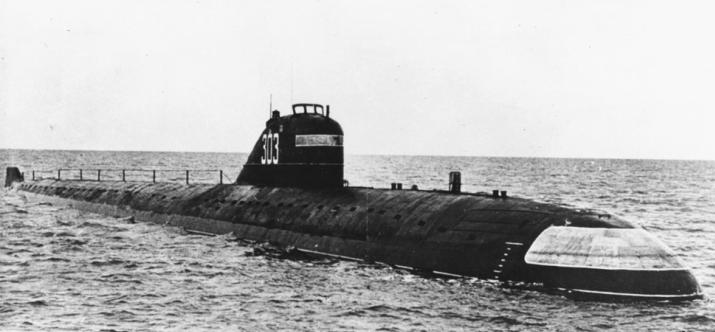
November Class Submarine

The November class submarine (Project 627) was the first nuclear-propelled submarine design of the Soviet Union. The first boat of the series was the K-3, which was commissioned in 1959, three and half years after the USS Nautilus. However, the design of these attack submarines had begun in 1952, under Vladimir N. Peregudov, at the Research Institute of Chemical Machine-Building, which would build the nuclear reactor for the Project 627 led by physicist N. A. Dollazhal.

The November class submarine was the first nuclear-powered boat to have a torpedo-shaped hull in naval history, since the USS Nautilus had a modified Type-XXI configuration. Vladimir Peregudov asserted that the submarine should resemble a torpedo in shape to fully exploit the power of her reactors. However, this new design in Soviet Navy was based on the USS Albacore (AGSS-569), which was a diesel-electric research submarine. According to Russian engineers, the Soviets had obtained details of the American submarine from a magazine photos.

Below, aerial view of the K-8, a Project 627A sub. Here, it was already in trouble off the coast of Spain in 1970. She would sink soon after this photo was taken. You can see her forward diving planes on the bow section are extended.


The first submarine of the series, the K-3, had been launched on August 9, 1957. She had gone to sea for the first time on July 4, 1958. Due to safety concerns, her nuclear twin reactor power plant first operated at only 60% until the completion of the test runs, reaching a speed of 23.3 knots. Later, her maximum speed would be 30 knots. Until then, the Project 627 was highly secret, with the last sub being retired in 1990.

Technical Description

The Project 627 submarine had a torpedo-shaped, double-hull configuration, with a reserve buoyancy of 30%, roughly twice that of the Nautilus, and internal pressure bulkheads. Internally, the November class submarine contained nine compartments (three more than the Nautilus): torpedo (bow); battery/crew; officers; reactor; turbine; two machinery compartments, and the stern compartment. The reactor compartment was located amidships and was fitted with two VM-A reactors, each supplying 70 megawatts thermal power.

The Project 627 boat was also equipped with electric motors for quiet low-speed operation, and in an emergency, they could drive her at 8 knots. Her inner pressure hull was built with the new AK-25 high-tensile steel, which provided the boat increased test depth. Thus, she would have a test depth of 300 m (985 feet), deeper than US Navy's contemporary submarines. The AK-25 steel had first been used in the Project 641/Foxtrot class submarine.

A coating of classified special material was applied to the inner hull to absorb own ship machinery noise to reduce the acoustic signature of the boat. Nevertheless, her noise levels increased at higher speeds. Although the first generation of Soviet nuclear attack submarines had a good speed quality and atomic installation two times more powerful than the US Navy's submarines, they significantly lacked in stealth at maximum speed.

Specifications (Project 627A)

Type: nuclear attack submarine

Displacement: 3,118 tons (surfaced); 4,750 tons (submerged)

Length: 107.4 m (351 feet)

Beam: 7.9 m (26 feet)

Draft: 6.4 m (20 feet)

Propulsion: two VM-A water-cooled reactors, producing 70 megawatts.

Maximum Speed: 30 knots (submerged); 15 knots (surfaced)

Range: 20 years, but limited to 70 days for food supplies.

Armament: eight 533-mm torpedo tubes, with 20 SET-65 torpedoes.

Below, the K-3 November class submarine. The photo was taken in 1964.


Victor Class Submarine

A Victor class submarine (Project 671) is one of a series of nuclear attack submarines developed and built by the Soviet Union during the Cold War. With the first one being commissioned in 1967, a total of 48 subs were produced in three variants; Victor I, II, and III. Today 3 of them still remain in active service with the Russian Navy. When it was introduced, it was the first Soviet attack boat featuring a single-propeller shaft.

Technical Characteristics

Made of AK-29 steel, the Project 671 submarine has a double-hull configuration. The pressure hull comprises seven compartments: torpedo/berthing/battery; command center; reactor; turbine; auxiliary equipment; berthing and diesel generators; and electric motors. The ballast tanks are located along her sides, between outer and inner hull, as well as in forward and aft. The Soviet AK-29 steel is the equivalent to the American HY-100 steel, which has a high yield and high impact strength used in marine defense. This extremely hard steel enables the Victor class submarine to submerge to a maximum depth of 450 m (about 1,400 feet).

In order to reduce self-generated noise, the Project 671 is fitted with limber hole covers, which close automatically the deeper it sails. Thus, they reduce flow noise over the hull. The versions Victor II and III (Project 671RT and 671RTM respectively) have anechoic (anti-sonar) coating on the outer hull, and dampening coating on the inner hull. The purpose of the dampening coating is to reduce the transmission of machinery noises.

The Project 671 is powered by a twin VM-4P pressurized-water nuclear reactor, and twin OK-300 turbine. The submarine was designed with a streamlined sail, which has contributed to her excellent underwater performance. The first version, the Victor I, had a two-reactor plant, with a single steam turbine rated at 31,000 shaft horsepower. The single propeller is situated 4.5 m (15 feet) aft of the stern control surfaces.

Below, a Victor III (Project 671RTM) submarine in 1983. You can see the large sonar array pod on top of her vertical fin. Her electronic surveillance mast is raised.


Armament

The Victor class submarine features six bow torpedo tubes; four 533-mm tubes, and two 650-mm tubes to launch the VA-111 Shkval and the Type-65 torpedo as well as the SS-N-16 Stallion anti-submarine missiles. The VA-111 Shkval is a fast and lethal supercavitating torpedo, which can travel underwater at 225 knots, which means more than 380 km/h (305 mph).

Specifications

Type: nuclear-powered attack submarine

Displacement: 7,250 tons (submerged); 6,990 tons (surfaced).

Length: 102 m (334 feet)

Beam: 10 m (32 feet, 10 inches)

Draft: 7 m (23 feet)

Propulsion System: a twin VM-4P nuclear reactor; two OK-300 turbines.

Maximum Speed: 32 knots (59 km/h - 37 mph)

Range: limitless but must moor after 90 days for food supply.

Radar:  one MRK-50 Albatros; Skat sonar system

Crew: 37 men

Below, a Victor II (Project 671RT) at sea in 1980.

Popular Posts